.svg)








































Three-month outlook sees turbulence with a 10-point drop in sales outlook score, while inventory, promotion, and hiring outlooks climb.
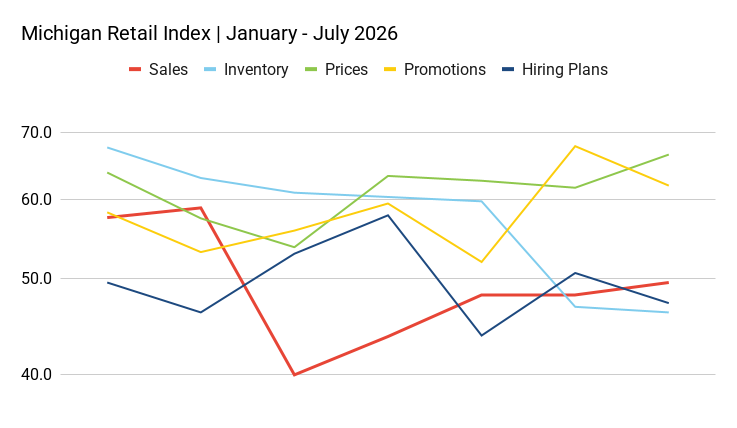
Michigan Retailers Association reports that February 2026’s Michigan Retail Index score came in at 48.1, marking three months of steadily declining index scores. Down slightly from January’s score of 49.5, this Retail Index remains seven points higher than last February’s score of 41.5, which was the lowest Retail Index score for 2025.
The 100-point index provides a snapshot of the state’s overall retail industry. With higher numbers indicating stronger activity, index values above 50 generally indicate positive sales activity. The seasonally-adjusted performance index is conducted by Michigan Retailers Association (MRA) in cooperation with the Federal Reserve Bank of Chicago’s Detroit branch.
This seasonally-adjusted index reflects how current retail sales compare to a historical average for each month. Thirty-five percent of retailers noted an increase in February sales over January, while 38% of Michigan retailers surveyed reported a sales decrease, and 27% reported no change.
February’s price adjustment index score came in at 61.6, showing stability from the previous month and, while still positive, a new low score for the past six months.
“With ongoing winter weather keeping shoppers at home, or traveling south for some respite from the cold, this February was a slow month for many Michigan retailers,” said William J. Hallan, President and CEO of the Michigan Retailers Association. “However, jewelers, grocers, and shoe stores reported increasing sales in February, reflecting Valentine’s Day gift-giving and the need for more weather-ready footwear.”
Tariff Uncertainty Continues to Impact Retailers
Nearly three-fourths of retailers reported negative impacts of tariffs in a March 2026 MRA member survey. More than 83% of retailers said they needed to make adjustments to their normal business plans and operations. Over 62% of retailers reported having to change item pricing, which has been reflected in higher-than-average Retail Index pricing scores and pricing outlook scores for the past several months.
3-Month Outlook
When asked about their sales outlook for the next three months (March through May), 88% of retailers predicted their sales would increase, no retailers anticipate their sales to decline, and 12% anticipate no change. That results in an index rating of 75.7 for the 3-month outlook, and a strong indicator for optimism, but a notable drop from the 3-month prediction last month at 85.3.
“The outlook remains strong, with nearly 90% of retailers expecting sales to increase in the coming months. Despite a 10-point drop this month, the three-month outlook is returning to a normal range after several months of record-high scores this winter,” Hallan shared. “Our members are ready for the spring season, and we encourage shoppers to Keep Your Money in Michigan as you prepare for warmer weather. Every purchase at a locally-owned retailer makes a positive impact on your community.”
The inventory outlook for the next three months rose again with spring inventory arriving and hitting shelves, increasing two points from last month to 67.5 in February. The promotions outlook also increased two points to 72.0 in February. The hiring outlook climbed four points this month to 58.6, the highest score on record since 2024.
Price Outlook Shows Stability
The price adjustment three-month outlook score stabilized in February, increasing just 1.2 points over last month to land at 70.2, after dropping more than 10 points in January. The score is comparable to last February’s score of 69.9, which was the lowest pricing outlook recorded in 2025. Following President Trump’s “Liberation Day” tariffs announced on April 5, 2025, pricing outlook scores climbed and remained higher than historical averages for the remainder of the year, with a high of 80.2 for 2025.
“This February’s score of 70.2, while still reflecting a likelihood of increasing prices in the coming months, brings hope that consumers may see more stable prices as spring approaches,” said Hallan.
.svg)